Frederick-Montgomery County Court Guide on desk with legal pad, case files, and courthouse preparation materials.

Frederick County and Montgomery County, Maryland

Frederick-Montgomery County Court Guide

Court can be confusing. This guide gives you a practical map for serious family litigation and related courthouse logistics in Frederick County and Montgomery County.

Circuit and district locations, docket resources, hearing preparation, and courtroom expectations. It is not legal advice for your specific case and not a substitute for counsel on your facts and deadlines. Consultations are by appointment. If something is on the calendar soon, call first.

At a glance

  • Use Local court basics for addresses, hours pointers, and official links.
  • Use How the two counties differ for pace, parking, and first-day logistics.
  • Use the sections below for hearings, documents, and courtroom expectations.

Local court basics

Below are the main circuit and district courthouse locations in Frederick and Montgomery counties, with links to the Maryland Judiciary for hours, directions, and docket postings. Your notice controls which building and courtroom apply to you. Confirm current hours, security rules, and parking before your court date. Details change.

Frederick County

Circuit Court

Downtown Frederick court square and courthouse area near Patrick Street.
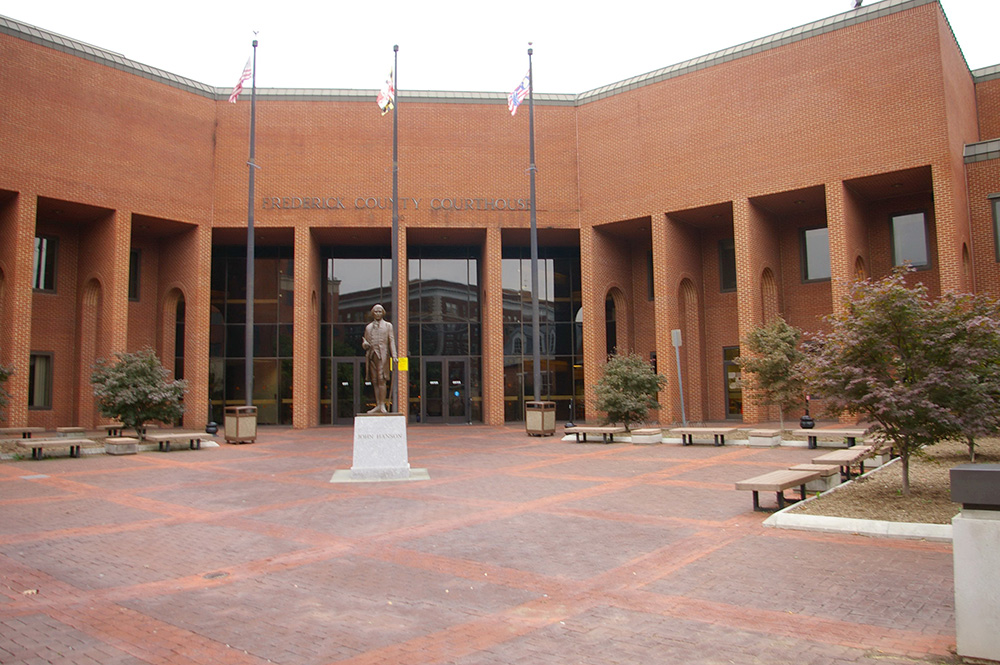
Downtown Frederick near the Patrick Street court campus. Photo: Acroterion, CC BY-SA 4.0, via Wikimedia Commons.

Address: 100 West Patrick Street, Frederick, MD 21701.

Clerk / courthouse: Circuit court operations and the clerk's office are at this downtown Frederick location unless your notice states otherwise.

Hours: The Maryland Judiciary's Frederick County directory lists 8:30 a.m. to 4:30 p.m., Monday through Friday (except state legal holidays). Confirm current hours on the official site or by phone before you go; departments and windows can differ.

Parking: Downtown Frederick mixes on-street meters, garages, and short walks to the courthouse. The clerk publishes directions and parking notes.

Arrival and security: Expect entry screening (bags, metal detection). Arrive early enough to park, clear security, and find your courtroom.

District Court

Same downtown Frederick court campus as the circuit court.
Same downtown campus as circuit; match your notice to the correct entrance. Photo: Acroterion, CC BY-SA 4.0, via Wikimedia Commons.

Address: 100 W. Patrick Street, Frederick, MD 21701-5548 (as listed on the Judiciary district page).

What sits here: Maryland District Court matters filed in Frederick County, including many traffic and misdemeanor dockets, civil claims up to the statutory limit, landlord-tenant, and other case types described on the Judiciary site. Family-related matters may be filed in circuit or district depending on the case; follow your paperwork.

Hours: The Judiciary lists the same general weekday block as other Maryland trial courts on the county directory (typically 8:30 a.m. to 4:30 p.m., Monday through Friday, except state legal holidays). Confirm on the official district location page or by phone before you go.

Parking: The Judiciary notes fee parking on Court Street for this location.

Montgomery County

Circuit Court

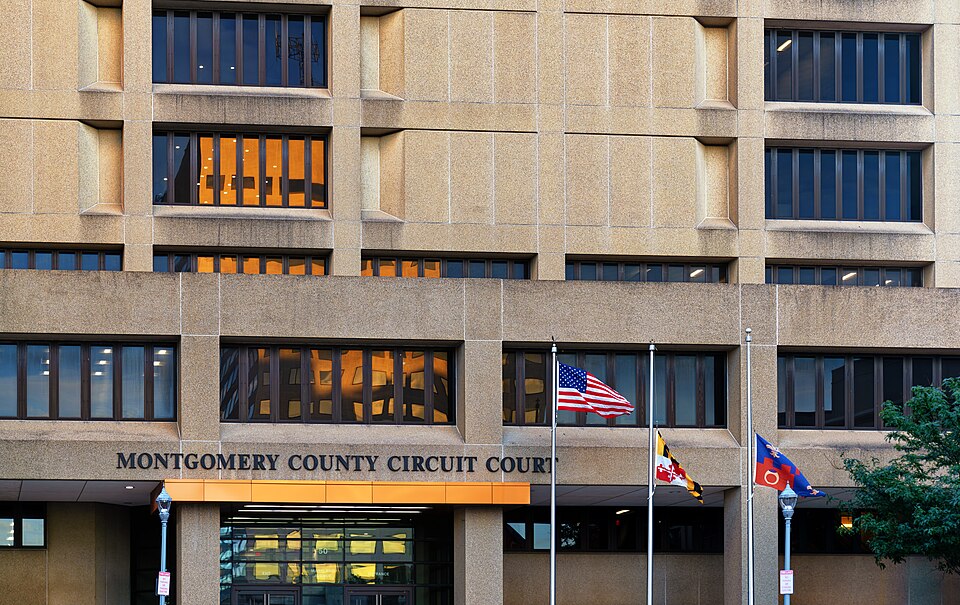
Montgomery County Circuit Court building in Rockville, Maryland.
Montgomery County Circuit Court, Rockville. Photo: Tony Webster, CC BY 2.0, via Wikimedia Commons.

Address: 50 Maryland Avenue, Rockville, MD 20850.

Clerk / courthouse: Circuit court and clerk operations for Montgomery County are centered here unless your notice directs you elsewhere.

Hours: The Maryland Judiciary's Montgomery County directory lists 8:30 a.m. to 4:30 p.m., Monday through Friday (except state legal holidays). Confirm current hours on the official site or by phone before you go; departments can differ.

Parking: Paid garages and metered street parking near the Rockville civic core. Build in extra time.

Arrival and security: Expect entry screening. Busy mornings can mean longer lines.

District Court (Rockville)

District Court of Maryland building in Rockville on East Jefferson Street.
District Court of Maryland, Rockville (East Jefferson Street). Photo: G. Edward Johnson, CC BY 4.0, via Wikimedia Commons.

Address: 191 East Jefferson Street, Rockville, MD 20850-2630 (as listed on the Judiciary district page).

General phone (as listed on the Judiciary page): 301-563-8800 for civil, traffic, and criminal matters at this location.

Hours: The Judiciary lists 8:30 a.m. to 4:30 p.m., Monday through Friday (except state legal holidays) for Montgomery County district locations. Confirm on the Rockville location page or by phone before you go.

Parking: Metered street parking and nearby garages; confirm current options on the Judiciary or Rockville pages linked from the directory.

District Court (Silver Spring)

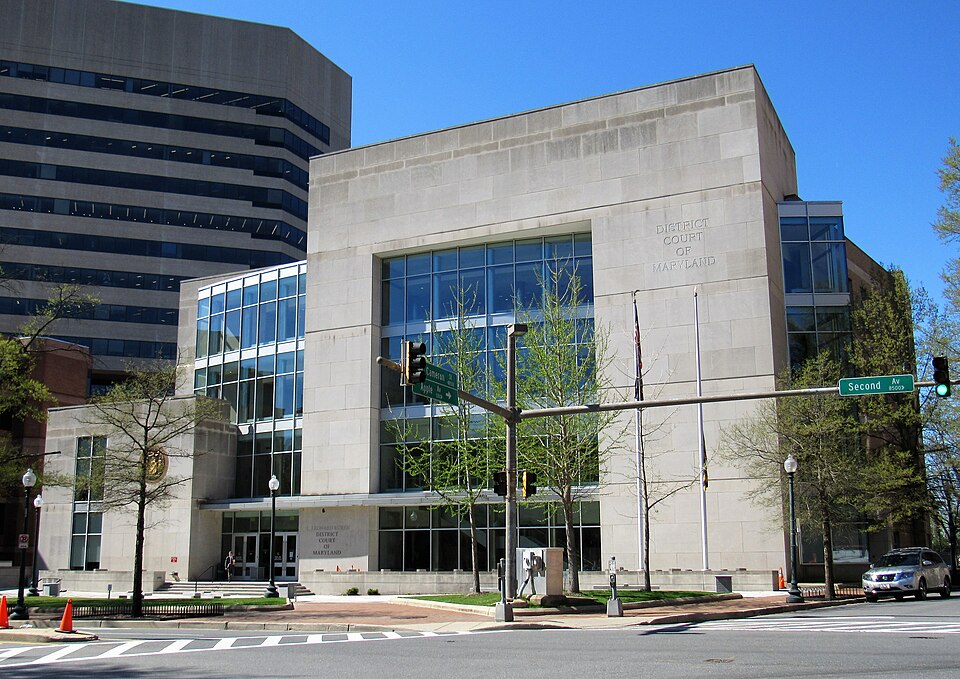
District court building in Silver Spring, Maryland.
Silver Spring district courthouse (often referred to as the L. Leonard Ruben building; match your notice to the address). Photo: Farragutful, CC BY-SA 4.0, via Wikimedia Commons.

Address: 8552 Second Avenue, Silver Spring, MD 20910-3364 (as listed on the Judiciary district page).

General phone (as listed on the Judiciary page): 301-563-8500.

Hours: The Judiciary lists 8:30 a.m. to 4:30 p.m., Monday through Friday (except state legal holidays) for Montgomery County district locations. Confirm on the Silver Spring location page or by phone before you go.

Parking: The Judiciary points to nearby public lots; confirm current options before you go.

Montgomery County lists two district court locations (Rockville and Silver Spring). Some filings and notices specify one or the other. If anything here disagrees with your notice or the live Judiciary page, trust the notice and the official site first.

How the two counties can feel different

Knowing where to go, where to park, what to bring, and what the first hour may feel like can reduce unnecessary stress before the legal issues even begin. Frederick and Montgomery share Maryland law, but courthouse volume, district court splits, and day-to-day logistics are not identical.

Frederick County

  • Smaller population base can mean a different docket density than Rockville, depending on the day and department.
  • Downtown Frederick courthouse access is walkable once you are parked; parking itself takes planning.
  • Your attorney's read on local motion practice and scheduling still matters more than anything you read on a website.

Montgomery County

  • Higher volume can mean crowded hallways, fuller calendars, and more buffer time for parking and security.
  • Montgomery has two district courthouses (Rockville and Silver Spring); the wrong address on the wrong day is an expensive mistake.
  • Same law, same rules of evidence, but day-to-day logistics and pacing can feel different from Frederick on comparable case types.

Introduction

Stress and uncertainty are normal in family court. The process moves by rules, calendars, and evidence, not by how loudly someone feels wronged.

Courts address issues in stages. Preparation, credibility, and a realistic grasp of procedure usually matter more than emotional volume.

If you feel overwhelmed, that does not mean you are failing. It usually means you are in a serious situation and need steady help understanding the path ahead.

What family court is actually like

That mismatch between emotional build-up and procedural time is common. It is not a sign your situation is unimportant. It is a sign that courts manage many cases and must move efficiently.

Scheduling changes happen. Continuances occur for good reasons and frustrating ones. The experience is often mundane and procedural, even when life at home is not.

Common stages of a case

Not every case follows the same path. Think of this as a map, not a promise of order or timing.

Early hearings and scheduling

Early appearances may address temporary issues: safety, access to children, support, or urgent financial stabilization. Judges often focus on what must be decided now versus what can wait for fuller information.

Scheduling conferences and short hearings can set expectations for deadlines and next steps. A brief hearing does not mean your concerns are small.

Continuances can be granted for good cause, discovery needs, or calendar realities. No responsible attorney guarantees a fixed timeline.

Mediation and settlement discussions

Courts push mediation because trials are expensive, slow, and hard on families. In both Frederick and Montgomery County, many contested family cases go through mediation at some point.

Mediation is basically structured negotiation. Most of the day is discussion, waiting, proposal review, and back-and-forth between rooms. It usually feels more like a long meeting than a dramatic courtroom moment.

Talking settlement does not mean your case is weak. Sometimes people settle because they want certainty, lower cost, or less stress on the children. Sometimes they do not settle because the gap is still too wide. Both outcomes are common.

Some cases fully settle. Some settle only a few issues. Some do not settle at all. Even partial agreements can narrow the fight and make the rest of the case easier to manage.

For a longer stand-alone walkthrough in the same plain-language style, see how mediation usually works in a Maryland divorce or custody case. Other short articles are listed on the Resources page.

What the day usually feels like

If you have never mediated before, expect a lot of waiting. The mediator may spend long stretches in the other room. Offers change over time. People rethink positions as the day goes on.

Separate rooms are common. So is frustration. Mediation can feel mentally exhausting even when everybody stays calm. Most people leave tired, whether the case settles or not.

Same day, in plain terms

  • Negotiation usually moves in steps, not one speech that fixes everything.
  • You may be in separate rooms for a big chunk of the day.
  • Quiet time in your room does not always mean nothing is happening next door.
  • Bring water and a snack if you can, and try not to stack something intense right after.

At a glance: roles, limits, and reality

Understanding the process

What mediation actually is

Structured negotiation with a neutral facilitator. You go back and forth on proposals, and when it works you leave with clearer written terms. It is not a trial.

What a mediator does

Runs the discussion, asks practical questions, and may carry numbers or drafts between rooms. Your lawyer stays your advocate. The mediator is not picking sides.

What a mediator does not do

Does not decide your case like a judge or replace your lawyer. You are not there to rehash who was right in the marriage. Expect problem-solving and paperwork talk, not therapy.

What to bring

Whatever your attorney lists: key documents, approved notes, contact info, charger, water, snacks, meds you take on a schedule. Skip the surprise binder unless your lawyer wants it.

What tends to happen in the room

What surprises people, and common pitfalls

The day often feels slow, with a lot of time on wording. Quiet stretches do not always mean nothing is happening. Watch for treating the first offer like it is set in stone, performing for the mediator, or texting the other side between sessions when you are supposed to be cooling off.

Why cases settle, and why some do not

People settle when they want certainty, lower cost, or less stress on the kids. They do not settle when the facts still fight hard, trust is gone, someone needs a judge to decide, or the numbers will not close. All of that is normal.

How to prepare

Sleep if you can, eat something simple, dress for a long meeting. Know how you will ask for a break. Let your attorney handle tone and strategy. You stay clear on what matters and you listen when options get explained.

When partial agreement still helps

You might leave with only part done: a temp schedule, one money piece, or an agreement to exchange documents. That can still shrink what is left to fight about. Do not sign until your lawyer says you understand what binds you.

Mediation myths

"If I compromise, I lose."

Not necessarily. Sometimes compromise buys certainty, lower cost, or a steadier long-term outcome than rolling the dice at trial. The real problem is signing terms you cannot live with because you felt rushed.

"The mediator decides the case."

Usually no. The mediator helps you test options; your lawyer advises you; a judge decides if you still need one. If someone says the mediator "ruled," ask your attorney what actually got signed.

"Everything must settle today."

Sometimes you finish. Sometimes you move partway and come back. Sometimes you stop and keep litigating. None of that, by itself, proves you did it wrong.

"The loudest person wins."

Volume is not a scoreboard. What matters is whether the terms work on paper and match the strategy your attorney is running.

"Being emotional means you are failing."

This stuff is heavy. Strong feelings happen. The point is not to pretend you feel nothing. The point is not to make big decisions off pure adrenaline. Use breaks.

"Good faith means I have to agree."

Good faith means you show up and engage seriously. It does not mean you have to take the last offer on the table.

Before mediation

Documents and preparation

Useful preparation usually includes a clear timeline, relevant communications when appropriate, financial records your attorney requests, and school or medical information when parenting is disputed.

Bring this (when counsel agrees)

  • Copies of current orders and recent filings your attorney names.
  • A short timeline of dates, not a novel.
  • Financial records you were asked to produce, organized and labeled.
  • Contact information for witnesses only if your attorney wants them listed.

Do not bring this unless asked

  • Unsorted boxes of every message you ever sent.
  • Recordings or materials your attorney has not cleared for use.
  • Weapons, tools that could read as weapons, or anything that will not pass security.
  • Children to a hearing unless the court or your counsel tells you to.

Short, factual summaries help your attorney more than long emotional narratives. The goal is clarity, not volume, and never harassment through paper.

What judges often care about

In general terms, courts weigh credibility, consistency, and whether your actions match your words. For parenting issues, child-focused reasoning matters. For financial issues, transparency and documentation matter.

Reality check: This is not a formula for gaming a judge. Individual judges apply the law to individual facts. Preparation, respect for the process, and realistic framing help more than speculation about a particular bench officer.

Courtroom behavior and expectations

Dress respectfully and arrive on time. Address the court politely; avoid interrupting. Strong emotion is understandable; unmanaged outbursts rarely help your position.

What clients misunderstand most often

  • "The truth will win quickly." Courts decide on admissible evidence and law. The full story rarely unfolds in one appearance.
  • "The judge already knows what really happened." Judges hear competing accounts. What is proven and presented matters.
  • "More emotion means more urgency." Intensity does not replace documentation, credibility, or legal standards.
  • "Long message threads always help." Length can obscure key facts. Curated, relevant communication is usually more effective.
  • "Every disagreement needs court action." Strategy includes choosing when court intervention is proportionate and viable.

Ready for case-specific advice?

This guide cannot tell you what to file, what to say on the record, or how your judge will rule.

Official tools

Maryland court resources

These official Maryland Courts tools are useful before and during a case. They are public resources, not affiliated with this office.

Maryland Case Search Portal

Look up publicly accessible case information, hearing dates, and court filings by case number or party name.

Maryland Court Help App

The official Maryland Courts mobile app provides court information, case lookup, and procedural guidance. Available on iOS and Android.

App store links may change. If a link does not work, visit the Maryland Court Help App page directly for current download links.

Support during litigation

Support resources

High-conflict family proceedings are among the most stressful situations people navigate. These resources address needs that run alongside the legal process. They are independent of this office; if any of them intersect with your legal matter, discuss it with your attorney before acting on them.

Co-parenting communication

In high-conflict cases, documented communication matters. These platforms create timestamped message records that attorneys and courts can review. Use on counsel's advice. The record applies to both parties.

OurFamilyWizard: widely used; courts sometimes order it

TalkingParents: similar model, straightforward interface

AppClose: co-parenting messaging and scheduling

Mental health support

Contested proceedings take a sustained toll. Having support outside the legal process is practical, not a sign of weakness.

988: call or text anytime for crisis support

NAMI Maryland: education, support groups, and a helpline

Find a therapist in Maryland: Psychology Today directory, filterable by insurance and specialty

Domestic violence resources

If safety is a concern for you or your children, these resources provide confidential support independent of the court process.

Heartly House (Frederick County): 301‑662‑8800, 24-hour hotline

Maryland Network Against Domestic Violence: 1‑800‑634‑3577, 24 hours

National DV Hotline: 1‑800‑799‑7233 or text START to 88788

Support for children

Children in high-conflict cases benefit from consistent support outside the legal process. School counselors are often a practical first contact.

Find a child therapist in Maryland: Psychology Today, filtered for children and adolescents

Frequently asked questions

How long does family court take?

It varies widely. Some issues resolve in fewer appearances; complex custody or financial disputes can take longer. Calendar availability and the need for discovery also affect pace.

Will I speak directly to the judge?

Sometimes, in a structured way. Often your attorney speaks on legal issues, and you answer questions when the court needs your testimony.

What should I bring to court?

Follow your attorney's checklist: typically orders, key records, and a written timeline if requested.

Do I need every document perfectly organized?

Neat organization helps; perfection is not required. Reliability and relevance beat sheer volume.

What if the other side violates an order?

Options depend on the order, the violation, and the law. Document concerns and discuss enforcement or modification with counsel rather than acting alone.

Does every case go to trial?

No. Settlement is frequent, but hearings still matter for temporary issues and for cases that cannot be resolved by agreement.

When you are ready to talk

You do not need every procedural detail sorted before you reach out. A consultation is where facts, risk, and timing get translated into a plan.

The office uses scheduled consultations; voicemail is fine for an initial message.

Next step

Orientation helps; it does not replace counsel. If you have a complex family matter in Frederick or Montgomery County, use a consultation to align facts, deadlines, and options.

50 Carroll Creek Way, Suite 230, Frederick. Consultation by appointment.